Here is a list of some of the things that have happened of note in the first four weeks of 2026:
- A fascist Kakistocracy led by an 80-year-old sociopathic narcissist dementia patient's private thug army composed of sadistic failed mall cops all behind on their child support payments murdered at least two US citizens in broad daylight and the depraved cowards leading said Kakistocracy then proceeded to blatantly lie to their citizens about it despite copious video evidence proving them wrong.
- The same fascist government threatened to invade Greenland upending the up until now most successful modern military alliance that had existed in its present form for the last 75 years. Then the morally depraved pedophile rapist-in-chief Herr Trump joked about doing the same to Canada.
- I got super sick probably with that new deadly Flu strain that while not as deadly as the low life incel army known as ICE is, is still pretty nasty. I then passed said deadly Flu strain on to Joelle and Heinrich. Strangely Helga was spared but it could be due to the chemically novel combination of poison and ice that flows through her veins where most people just have blood.
- The airline lost all of our suitcases for two weeks and when they finally returned mine it was delivered in pieces. Someone seemingly had been rehearsing for their ICE job interview and in the course of trying to destroy an inanimate object that they saw as a threat to their personal livelihood took a sledge hammer to the hard plastic shell and left it in tattered ruins.
- Elon Musk gave a talk at Davos. Why? Why does anyone listen to that wind bag shit head? Stupidest man on Earth.
215 years ago, in the year 1810, not-yet (but soon to be) King Ludwig was wedded to the (probably?) beautiful Therese Charlotte Luise of Saxony-Hildburghausen (or maybe not so beautiful? They didn't yet know about DNA and all that...). The official wedding took place on the evening of October 12th (a Friday -- you can look these things up! [or quickly calculate it in your head if you are some kind of polymath]) and the celebration of the new marriage continued for five whole days where all the people (well I doubt ALL the people; I'm sure also back then if you weren't rich and well-connected nobody cared about you) of the city of Munich were invited to partake in the festivities.
Said festivities presumably included drinking beer (monks had been brewing beer in Munich since the 14th century after all) but the big hit at the OG Oktoberfest was the inclusion of horse races (I know right?). The horse races were such a big hit in fact that the city organizers couldn't have not run the whole thing again the next year (there was gold to be bought you know). While horse races were the advertised main draw, the beer of course was also an important element of the festival. It wasn't until towards the dusk of the century, however, (why does it sound normal to say "the dawn of time" or "the dawn of the century" but dusk doesn't seem to be typically allowed to be used in such a metaphor? unfair for a good word that has kept its head down just doing its job for so long) that the beer stands were replaced (in 1896) with the huge brewery-sponsored beer tents that we know and love to this day.
There are people (cough, cough, Americans) who like to point out (since they once visited the Oktoberfest) that isn't it crazy that it's called the Oktoberfest but it takes place in September!? Like look how clever and traveled I am that I know this. But honestly the weather in October is just too cold and unpredictable and while you do spend the bulk of your time sitting inside a very warm tent nobody wants to be cold on the way to and from the Wiesn! (fun fact: the Oktoberfest takes place on the Theresienwiese which translates to "Therese's Meadow" named after the erstwhile bride which is as the name so cleverly suggests a giant meadow in the middle of the city and for some reason the locals just call the Oktoberfest the "Wiesn").
But in my eye, though the festival has existed for more than 200 years and very much in its current form for more than 100, the Wiesn really peaked in the year 2013. I think that I've gone every single year at least once since then, but it's never been as good. Why not? It definitely has nothing to do with my age.. that's for sure.
It's hard to imagine now, but 2013 was probably the last time that not every single person there had a smartphone that they were completely absorbed in. Yes, the iPhone was introduced 6 years before that and most people had a phone of some kind. Instagram had existed for almost 3 years but it was still primarily a way to share photos directly with our friends and family. There was no TikTok, the camera quality was meh, there wasn't enough disk space or mobile data to share videos, the UX model was less addictive, and cultural norms were different; it would be weird to just sit there scrolling through your phone. As smartphone saturation arrived, it changed crowd behaviour, people became more "show-y", and social media like Instagram began to attract people to major events like the Oktoberfest not because they wanted to go and have fun, but because they want to film it and make it look like they have a full life. Which leads to the next reason that 2013 was peak Oktoberfest...
More people meant more commercialization, overcrowding, rising prices (you could get a Maß [1L] of Oktoberfest beer along with a tip for under 10 Euros in 2013; now it's more like 18 Euros), and worst of all: more Americans. Oktoberfest always attracted a lot of Americans, but now there are even more. No thank you.
Another unfortunate thing that has led to a less enjoyable experience (the terrorists truly won) is that major high-profile terror attacks in Europe like Charlie Hebdo in Paris in 2015 and the Berlin Christmas Market attack in 2016 have resulted in the requirement of all kinds of additional security procedures to be put in place. These are obviously important but make getting into the venue like going to a concert or something where you're not literally stuck but you're not going to go to the trouble to leave and come back.. but even in the first place if you decide to go for let's say one beer or a meal at lunch one day it doesn't really make sense because you need to stand in the ONE single entry point queue where the security guards / police can check everyone coming in and this can take up to half an hour! In 2013 you could walk up out of the U-Bahn and just be in the Wiesn. Booooo to terrorists.
Funnily enough, while I'm bah humbug! about Oktoberfest now, I have come to enjoy the Christmas markets which wasn't always the case! (see "Christmas is coming" on GWMD, Nov. 20, 2014)
Nicholas Carr hammers it home: we're doomed. You can probably tell what the book is about, what Carr's thesis is, and probably already have a cemented opinion about it just by reading the subtitle: "How technologies of connection tear us apart". But according to Carr, your initial gut feeling is probably wrong (or at least not fully correct) and his conclusion is very pessimistic.
The book starts by going over the history of communication technologies and how each major breakthrough was greeted with near identical optimism. I was bemused, at least, to read examples that could have -- with a few words changed here and there -- come from one of many Wired magazine articles from the early 2000s talking about the peace and utopia that the Internet would bring. Some examples:
In 1865, the International Telegraph Conference (to draw up the "International Telegraph Convention" that would define "an intergovernmental treaty that established the basic principles for international telegraphy") declared itself “a veritable Peace Congress,” suggesting that all misunderstandings that previously led to war would be eradicated by the ability to communicate swiftly through telegraph lines.
Nikola Tesla, because of his early work in telecommunication and wireless technologies, predicted that he would go down in history as “the inventor who succeeded in abolishing war.” There's another quote from the early 20th century that I unfortunately can't find right now which says something along the lines of "when a man can communicate quickly and cheaply across borders it is inconceivable that he would ever go to war again".
Obviously -- obviously -- the early optimism is always grossly not just over-optimistic but entirely off-target and, well, wrong. Including, again obviously, the Internet, social media, etc. Carr makes a lot of interesting points in this book but the thing I want to focus on is the cause(s) of increased support for fascism, far right insanity, dangerous radicalization online, etc. One partial explanation that pops up often and that I'm sure at least crossed your mind in the intro is that of the "online echo chamber". Basically, the algorithm learns what we like and just keeps giving it to us. So not only do we think everyone thinks like us, but we get more and more "deep" into that viewpoint and start taking more and more extreme views that fit into our political leanings and as others get more and more exposure they also get more extreme and the cycle continues. Add in mis-information and you've got a full recipe for radicalizing people and making a fully polarized society.
That on its own is bad enough. But what's even scarier is the conclusion that (1) the algorithm / echo chamber explanation is not the root cause; and (2) it's just human nature:
"The phenomenon of online polarization and extremism is not, as some have suggested, a manufactured product of algorithms. Instead, they are manifestations of deeply ingrained tendencies in human nature that have invariably influenced and strained social relations and political debates."
Carr points to a both unsettling and very interesting study where participants were categorized into "left" and "right" groups after filling out several survey questions. Half of each group was put into a version of the experiment where they saw only social media posts that matched their prior beliefs (the echo chamber). At the end (it was a long-running study), they were asked further questions to see what effect this might have had on them. On average the left group members became a little more left and the right group members became a little more right.
The other half of the participants got a version of the experiment where the social media posts they saw were designed to give a good balance of views they agreed with and views they were opposed to. You would think this might help to counter the echo chamber phenomenon. But at the end of the study, both groups were even more entrenched in their beliefs than the echo chamber participants were. This could be because your brain starts actively working to fight against what the other side's points are and you therefore have to double-down on your views to be able to fight their points more successfully. But it shows that just the echo chamber (while clearly not ideal for many reasons, especially before you've formed an opinion on an issue) is not the only problem. From Superbloom:
The researchers conducted a second round of experiments to examine why a more balanced information diet stimulates greater partisanship. Recruiting new sets of Democrats and Republicans, they again deployed their bots to tweak Twitter feeds, but this time they also held extensive interviews with the subjects. They found that exposure to an opposing view triggers a sort of immune response within a group. Members band together even more tightly to defend their position against what they perceive as an invasive idea. People "experience stepping outside their echo chamber as an attack upon their identity," Bail reports. That makes "differences between 'us' and 'them' seem even bigger." Groups are just as prone to dissimilarity cascades as individuals are.
Finally, this got me thinking about how this manifests in practice. And I had an example already. As the vast majority of Canadians were just starting to get to know Mark Carney a little over a month ago, he gave what I saw as a fantastic answer to a ridiculous question from a so-called reporter. Watch the video below:
The important bits:
"Reporter": Umm you have not been elected in a federal election yet and you recently flew to uhh duhhhh Europe on a government wide-bodied jet (???) at the expense of at least half a million dollars so the question I have for you today ummmm and maybe I'll say this before I ask the question, these people <duhhhhh> around you all paid for that flight??? and you've not been elected yet, so will you commit, to, refunding these tax payers for that flight?
Let me just interject here to point out that this was the most embarrassing waste of time question that I think I've ever heard a so-called "reporter" ask. Embarrassing. Back to the good stuff though...
Prime Minister Mark Carney: Well it's an interesting question.. uhh.. way of framing it. [Gives us an extremely well thought out answer to the stupidest "question" ever]
"Reporter": I'll take that as a "no" then.
Prime Minister Mark Carney: No you'll take that as a very comprehensive answer to your question.
Ok. So there's so many things wrong with that ridiculous question. That style of "gotcha journalism" that doesn't actually seek any information but rather aims to get a "aha" moment for a very-specific, very-partisan viewership. The fact that he completely failed is hilarious and the answer from the PM is so good but then is overshadowed completely by the amazing off-the-cuff answer to the "reporter"'s pathetic attempt to close out his "gotcha" question with "No you'll take that as a very comprehensive answer to your question".
I was so happy to hear that. It was the moment I knew that Mark Carney had the right stuff to win the election and not only that, and much more importantly, he actually made me proactively want him to win. Previously I was hoping simply that PP wouldn't win because he's just so awful. But Carney's educated responses, answering in full sentences -- paragraphs even -- and not going directly to slogans, and his wit! I was actually quite proud.
So finally now I'm going to get back to the point. I originally saw the clip in my own personal echo chamber of Threads (in case you don't know it it's another Twitter basically) and it was obviously being passed around by the good guys (obviously whatever side you're on is the good guys side -- Tom Darling taught me that). And it felt so clear to me that this video is objective evidence that Carney is the real deal.
BUT, because I can recognize my biases and I don't want to get too caught in the echo chamber (even though it's not the actual cause of our poarized times apparently), sometimes I like to reset my cookies/cache/preferences/etc. and see what the other side (the bad guys) are seeing. And (I'm imagining that you probably see where this is going?) I saw... THE SAME VIDEO! But, why are they sharing this video? Have they finally seen the error of their ways? NO! It's the SAME VIDEO but the conclusions are entirely different. Instead of comments like
"The reporter is a clown. He was trying for a gotcha and got owned. Quite pathetic."
or
"This reporter is like a 15 year old boy trying to troll the principal. Grow up and ask a real question."
or
"That was such a wonderful response and handling of that question."
there are comments like
"Finally! A real question. The fact carney couldn't answer is tragic. He's trumps twin"
or
"Protect that reporter at all costs!"
or even
"Carney has very poor communication skills- dodged the question, gaslight the reporter, then be condescending."
So you don't even need the echo chamber because people see the EXACT SAME VIDEO but take away a completely different message. Man those bad guys...
Sure am glad the Liberals won though. And that PP lost his seat. Good times.
As a die-hard Jonathan Franzen fan, it's been a long 3 years, 5 months, and 9 days since the publication of Crossroads way back in October of 2021. This wasn't the thick of Covid but we definitely weren't yet out of the woods. It was a lull. Travel wasn't yet ubiquitous and the Omicron variant was silently building up steam to ensure that any Christmas 2021 adjacent plans would surely be destroyed. But Crossroads arrived right when us in the Franzen-verse most needed it.
A new JF novel is a big deal, of course. His previous, before Crossroads, was 2015's Purity. A LITERARY EVENT. And this came a full five years after his previous novel, Freedom, which came out all the way back in August of 2010. But the arrival of Crossroads was all the more monumental because of how it was billed: the FIRST ENTRY in a TRILOGY. A TRILOGY you say!? And not just any trilogy, but "A Key to All Mythologies". This was turning out to be the greatest October 5th since 1962 when the first ever film in the Bond Series, Dr. No, was released in UK theatres.
The novel itself is vintage JF. An American family at the centre of it, all with their own very specific problems. Hyper realism. Completely unlikable characters. Some kind of downfall. And, often, a redemption arc ending in vindication and/or redemption. Not knowing anything about literature, missing most of the subtleties of social commentary and other literary devices that probably lead to interesting ideas about the human condition especially as it relates to nihilism and the lack of religion on Western life, and the fact that these books aren't thrillers or mystery novels forcing you to turn the pages as fast as possible to find out why that happened or who the killer is, leads me to believe that the thing that I, as a Die Hard Jonathan Franzen Fan (TM), enjoy is simply the circularly defined fact that reading his books is a pleasurable experience. I just really like doing it.
And so the implied promise of at least two more novels still coming from JF, in the midst of the Covid depression that nothing would ever be as it was, provided some hope for simple enjoyments to come. But as I pointed out above, it's now been 3 years, 5 months, and 9 days and we haven't even heard a peep about what might be coming next and when. And what's really scary about this is that his novels tend to be announced WAY before they're published. For example, while I (obviously) pre-ordered Crossroads weeks before it was available, and therefore had it in my cold non-dead hands right on the 5th of October, his publisher actually announced the novel (and there were rumours and peeps and all that even before this) in November 2020!
So while we wait for Crossroads 2 or whatever it might be called, he's probably written 9 or 10 essays on birdwatching in the last few weeks if you're interested.
What better time than this weekend's gilded reopening of the Notre Dame Cathedral to finally discuss France's answer to Hank Moody, the always strange but strangely quite enjoyable Michel Houellebecq. Houellebecq (which is kind of a lot to have to type for some reason so henceforth I shall refer to him as H, not to be confused with Hank Moody of course, or with Helga or Heinrich) is probably not only the most famous modern writer in France but maybe even the world. Now I don't mean famous like J. K. Rowling or the Twilight lady famous. I mean famous for writing good books that are interesting and get people talking and enflame tensions (as they say) and cause controversy and all that other good stuff (yes J. K. causes controversy but that's because she is a bigot and it has nothing to do with her books except that the only reason we know she's a bigot is because she's famous [the other kind of famous] from writing those books).
Apparently a lot of people really don't like H because he kind of comes across as a misogynist and because of (at least) books like Soumission he is also called an Islamophobe. He's also kind of controversial because of his enfant terrible provocative persona which includes going to press conferences drunk and making passes at female reporters. And then there's the whole gratuitous use of weird sex scenes in basically all of his books. It seems that there are people who try to argue that it's super deep and has important connections to exploring societal decay. I personally would call it "provocation as a literary tool". Unfortunately it's a little overused and if that's really what he's going for he should probably use it a bit more sparingly because you kind of get desensitized to the whole thing.
Another common theme that one hears about H is that he is a modern prophet. La carte et le territoire is often claimed to have foretold the rise of digital art and that stupid NFT thing that thankfully died out a year or two ago. There's also the rise of celebrity culture but IMO this isn't so much prophesizing as just exaggerating what was already happening in 2010. Then there's Soumission which is one of his more famous novels and definitely brought up in the prophet theme. There it's about a Muslim political party coming to power in France and the country becoming "Islamic" (I guess?) very quickly and is partly an examination of the rise of political Islam in France. The thing here is that it came out literally the exact same day that the Charlie Hebdo office was attacked by Muslim Extremists in Paris and 12 people died including (I've heard) H's best friend or something like that. Finally (well not finally as in it's the only other example but finally as in it's the last one that I have the appetite to mention now) there's Sérotonine. This is an interesting book for several reasons and there are many arguably prophetic things about it but I think the most commonly raised is that in the book's climax the protagonist's (an agricultural scientist who has become sympathetic to the local farmers in Normandy because their traditional way of life is not just "threatened" but basically can no longer congruently exist in modern society) farmer friend leads an uprising with other farmers who feel they have nowhere to go and they try to stop the import of cheap foreign dairy. So the thing is that everyone in the media sees a direct link from this to the gilets jaunes protests that for a long while brought Paris to a stand-still in around 2018-2019. But if you read that book it had almost nothing to do with French agriculture or the fact that globalization is helping to destroy it. It was just an example he chose and the point was economic inequality, the decline of rural France in general, and (most importantly as it is a theme tying through all of H's books) the erosion of meaning in a secular society (which is really what Sérotonine is about).
Which finally brings us to H's most recent book, Anéantir (which is translated as Annihilation for some reason even though it should really be Annihilate but I digress). I just finally finished Anéantir and let me tell you it's a doozy. Now I'm no literature expert and when reading a book in French I really probably only understand 80% of the words if I'm lucky. But Anéantir is gold (despite one misstep which we will get to in due course). The novel has what seems at first glance to be the standard middle aged slightly depressed with of course strange sexual appetites (but nothing compared to most of H's protagonists) main character that we know and loathe from the books of H past. But Paul Raison is reasonable (lol!) and dare I say it, almost likeable? He is some kind of government employee who is the personal assistant to the successful finance minister Bruno Juge (who is very obviously based on the real finance minister Bruno Le Maire (lol!)). I can't go through everything in the book because SO MUCH HAPPENS (we also randomly read through at least a dozen of Paul Raison's dreams) but the important bit that ties a lot of it together is that there is some kind of secret group that none of the world's intelligence agencies have any clue about that is committing terrorist-like attacks that are quite baffling. It concerns our characters in multiple ways. The first "attack" is not an attack in the traditional sense because it's only some kind of hyper realistic video that is put online of Bruno being decapitated and it's spread all over the Internet. But then also Paul's dad, who has recently had a stroke and can no longer speak or move his body of his own volition, is a former French intelligence officer (since retired). The attacks become more brutal in that they eventually become actual attacks and people actually die. Another strange thing about this book in the context of the H literary universe is that despite all the sadness (Paul gets cancer and dies at the end of the book -- oops, spoiler alert -- and his brother commits suicide, and his father has a stroke that paralyzes him, and he mistakenly has a brief sexual encounter with his sister's daughter among other not-exactly-happy things) it's a pretty happy book in a lot of ways. Paul and his sensible, prudent estranged wife Prudence (lol!) live in the same house but haven't so much as touched each other in a decade and live in separate rooms and don't even really communicate. But his father's stroke seems to be the catalyst that starts bringing them together and over about 800 pages they slowly (and then very quickly) fall back in love and the last 100 pages of the book are basically in my opinion a sad+happy and beautiful philosophical "treatise" (I doubt that's the word) on a man coming to terms with his death.
But now the fatal flaw that almost ruined the book for me. So this is supposed to be serious literature. A lot of H's books (including this one!) are very funny sometimes and basically his entire oeuvre is satire. But the content and the topics and everything is kind of serious, even if the way it's portrayed is sometimes a little goofy. But plagiarism is too much! And from a 1990's video game!? Now, I'll accept that maybe -- just maybe -- it's a giant coincidence and that Michel Houellebecq didn't spend hours playing Police Quest III: The Kindred in the early 90's. But how else do you explain the following?
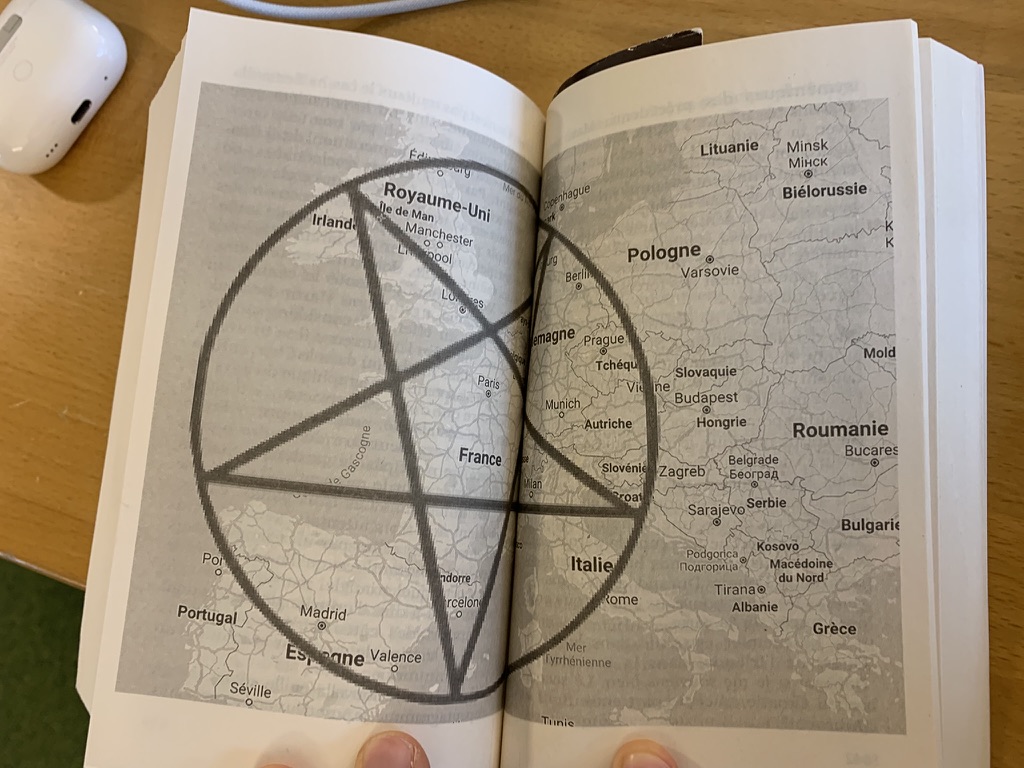
In Anéantir, as you'll recall, there are these attacks going on which had started before Paul's dad Édouard's stroke. At some point later on when Paul is at the family home going through documents for some reason (I can't remember why), he comes across some strange looking files that he somehow thinks are related to the attacks. They include Baphomet:
Baphomet is some kind of deity that's been incorporated into all kinds of occult traditions. Anyways, Paul shows it to his dad who can now somewhat communicate by blinking his eyes "yes" and he seems to confirm that it has to do with the attacks. So Paul calls up his father's spy friends and shows them the document and eventually, because of the pentagram on his forehead that is I guess an important part of this cult or whatever it is, they use that and the locations of the previous attacks to know where the next one is going to take place and prevent it.
Unfortunately I just couldn't help myself from laughing at this part. Because this is THE EXACT PLOT AND WAY THAT YOU SOLVE THE MURDERS in Police Quest III: The Kindred (written by former police officer Jim Walls).
But besides that? Great novel, 10/10, would read again.
More than one year ago Pemulis changed jobs. By the grace of God and the power of capital markets that have no connection whatsoever to economic fundamentals said job still exists today. By law you must have health insurance in Germany. Not having it is just plain verboten. Pemulis's old job ended on September 30th, 2023 and his new job began (because it was a Monday) on October 2nd, 2023. The astute reader will notice that for one day -- October 1st, 2023 -- he was without health insurance. Which is clearly, as we say in Germany,* a faux pas.
Having been a German resident for some 10 years at that point, Pemulis was cognizant that this one unemployed day could (nay, would) pose a serious problem for the powers-that-be in the German bureaucracy and beyond. And so he carefully planned for attempting to avoid such a complicating (and illegal) factor and spent many trying hours with the Krankenversicherungs people trying to arrive at a solution for what would be done about that ominous potentially uninsured day at the beginning of October.
Phone calls were had. Many of them. E-mails were written. It was suggested at one point that Pemulis work with his new employer to try to change the start date from October 2nd to October 1st (a Sunday). Ze German representatives of said employer in Germany said "Nein! That is a Sonntag! You will start on Montag!". "But my health insurance!" pleaded Pemulis. But rules be rules.
The lovely folks at Health Insurance R Us (or some German equivalent) finally caved and said look, you have two options: you can pay for that one day which we don't recommend because if you don't have income on that day then you just have to prove that you don't have income on that day and then you won't have to pay. And Pemulis said great I'll take that option. But then the only way to prove you don't have income is to apply for Arbeitslos (unemployment) support for one day but then that affects your future taxes and all this undesirable stuff so Pemulis said Listen, I'd be happy to pay for this one day. And they said OK but it's not the best idea because you'll be charged the maximum. OK.
And then nothing happened. Everyone went about their business, life continued, and no one ever heard about the problem again. The Krankenversicherungs people were seemingly happy. They said nothing. No bill was sent. No money was taken out of Pemulis's bank account. The problem just faded into the background.
Until November 15th, 2024.
November 15th (13.5 months after the fact), the Krankenversicherungs people noticed a problem. At one point, more than one year ago, for 24 hours, Pemulis lacked health insurance. This is verboten. The Krankenversicherung was displeased. The government would be unhappy. There would be forms to fill out. There would be problems. This did not bode well.
Eventually Pemulis would be face to face with a nameless representative of the Krankenversicherung.
"I know it's ridiculous" sighed the representative.
But you need to make a choice: you can either pay for the one day (but it will be the maximum amount! [normally it is a percentage of your income but without any income you either don't pay at all -- but have to prove no income -- or you pay the maximum) or you prove that you had no income on that day so many months ago. Pemulis thought he had already made that choice (in fact he'd completely forgotten about it since it was, you know, about 14 months ago). He said "I will pay". The representative said OK, you must fill out these 914 forms. And he did.
One week later a bill arrived. The bill. For Pemulis's health insurance for one day from 14 months ago. And it was painful. It was difficult. But the 7 euros and 12 cents were transferred to the Krankenversicherung and all was again right in the Bundesrepublik.